How to Stick Stucco Back Again
October i, 2018
Past Matthew Innocenzi
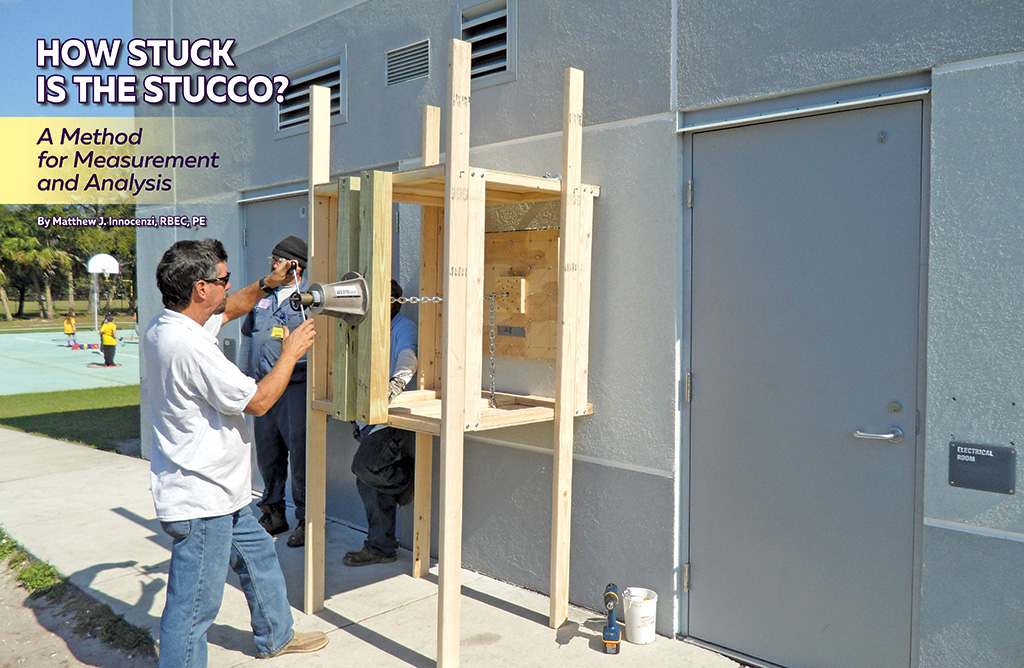
Stucco is a popular and versatile cladding material that is commonly constitute in the southern U.s.. The application of stucco can be broken into 2 cardinal categories, depending on the substrate to which information technology is applied: (1) straight-applied stucco and (ii) stucco over lath. In the former application, stucco is practical over a solid substrate, which is divers equally one that has the proper suction characteristic to absorb water, but it is not adversely affected by moisture. Examples of solid substrates include cast-in-place concrete, concrete masonry units (CMU), stone, and brick masonry. In the latter awarding method, stucco is applied over lath. For years, lath was predominantly manufactured of metal, but contempo developments of ASTM standards now include non-metallic (i.east., plastic) lath. Lath is used in conjunction with accessories that serve a diversity of functions, ranging from performance to aesthetics.
The awarding of stucco is predominantly governed by ASTM C926, Standard Specification for Application of Portland Cement-Based Plaster. ASTM C926 is germane to plaster, regardless of its application (i.e., direct-practical or stucco over board) and addresses stucco mixes, thickness, curing, and surface preparation, to proper name a few. The companion documents to ASTM C926 include ASTM C1063, Standard Specification for the Installation of Metallic Lath and Accessories; and ASTM C1787, Standard Specification for the Installation of Non-Metallic Lath and Accessories, which, equally their titles imply, pertain to the materials and installation of the lath and accessories for stucco-over-lath construction. For the purposes of this article, the writer will focus on ASTM C1063 (metallic lath) when referencing stucco-over-lath construction.
Stucco cladding is a prescriptively specified associates, meaning that its constituents, mix, installation of lath and accessories, and awarding of the stucco itself must comply with the ASTM C926 and C1063 standards to exist rendered adequate. There is no performance standard for the structural resistance of stucco cladding. Until recently, in that location was no industry standard that provided a consensus-based method for testing the stucco. The lack of whatever scientific testing or ways for evaluating stucco cladding afflicted both types of stucco in the manners described below.
Direct-Practical Stucco
ASTM C926 addresses the application of direct-applied stucco. Section 5 of ASTM C926 requires the surface be prepared to receive stucco past scarification or roughening of the substrate to provide a mechanical interlock. Bonding agents can also be used—oftentimes in conjunction with the scarification—to enhance the bond between the stucco and substrate and between individual stucco coats. In cases where bond cannot be achieved through scarification or bonding agents, ASTM C926 requires installation of lath and accessories in accordance with ASTM C1063. In that location are no quantitative data for the bond strength, nor is there a consensus on what the bond force should exist.
Stucco Over Lath
Like to straight-applied stucco, ASTM C926 also governs the mix, curing, and application of stucco-over-board structure. In this application, ASTM C926 is used in conjunction with ASTM C1063 for the installation of the metal lath and accessories. ASTM C1063 requires lath fasteners be spaced at 7 in. on center along the length of supports (eastward.g., studs), which are to be spaced at either 16 or 24 in. on eye. Every bit with other stucco awarding and lath installation requirements, the fastener spacing requirements are prescriptively based. In fact, the unusual fastener spacing of vii in. on middle was derived from locations of ribs on high-rib lath; ribs were located at the 1-quarter points, forth the width of the board, which was manufactured in 28-in. sheets. There is no scientific basis to validate or evaluate the adequacy of the 7-in.-on-center spacing. Interestingly, the writer is aware of anecdotal bear witness that suggests the seven-in.-on-center spacing may not be suitable for certain high-air current regions along the southeastern declension of the U.s.a. because the lawmaking-prescribed wind loads tin exceed the calculated pull-off strength of the board. As with direct-applied stucco, at that place are no quantitative data regarding the pull-off resistance of the ASTM C1063-mandated fastener spacing.

In March 2018, a new test method, ASTM C1860, Standard Exam Methods for Measurement of Tensile Strength or Bond Force of Portland Cement-Based Plaster by Direct Tension, was developed and adopted within ASTM C11.02 subcommittee (Specifications and Test Methods for Accessories and Related Products) to measure out the pull-off resistance of stucco panels in both direct-applied and stucco-over-lath applications. The new test method was drafted in response to not bad uncertainty and controversy within the manufacture on how to evaluate the pull-off testing. The task group responsible for the development of this examination method opted for larger specimen sizes to capture an accurate representation of the stucco application and avoid isolated areas of poorly bonded stucco. Representative photographs of the pull-off testing are provided in Figures ane through 4. More detailed information on the size and location of the examination samples is found subsequently in this article.
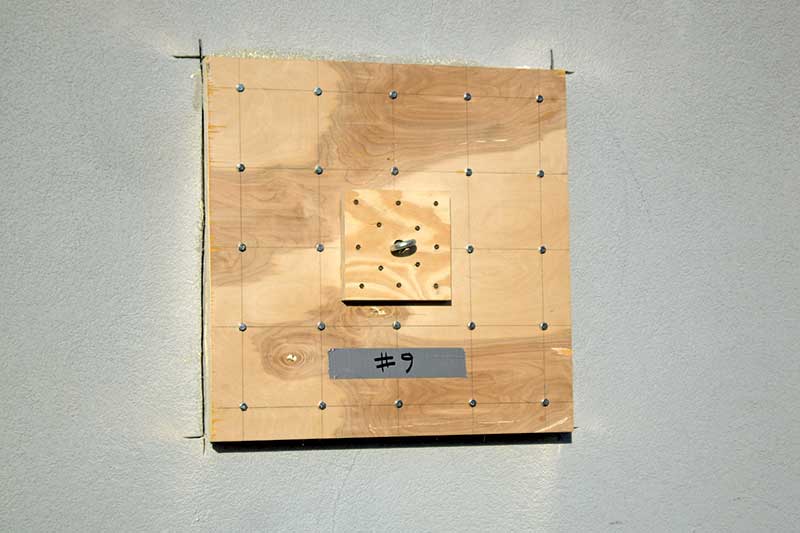
Although acceptable pull-off resistance values are a topic of great debate, no language about these values is provided in the principal body of the examination method; some commentary on failure loading and calculations of site-specific safe factors is provided in the non-mandatory appendix. Some consultants believe that as little equally three psi bond strength in direct-practical stucco is all that is required, as this value represents nearly 430 psf, which is almost double the greatest air current load calculated using the process in ASCE seven. Other consultants will reference industry standards from other edifice materials, such as concrete or masonry, in an endeavour to correlate an advisable bail strength for stucco. For example, ICRI recommends a bond force of 150 psi for concrete deck overlays. The author opines that reference to a concrete deck overlay is inappropriate for stucco and taken out of context. Moreover, the writer believes that such an extreme value is not required for stucco bail strength. Even with the new industry-wide, consensus-based exam method on how to test the stucco, the selection of an acceptable value for stucco pull-off is left to engineering judgment.
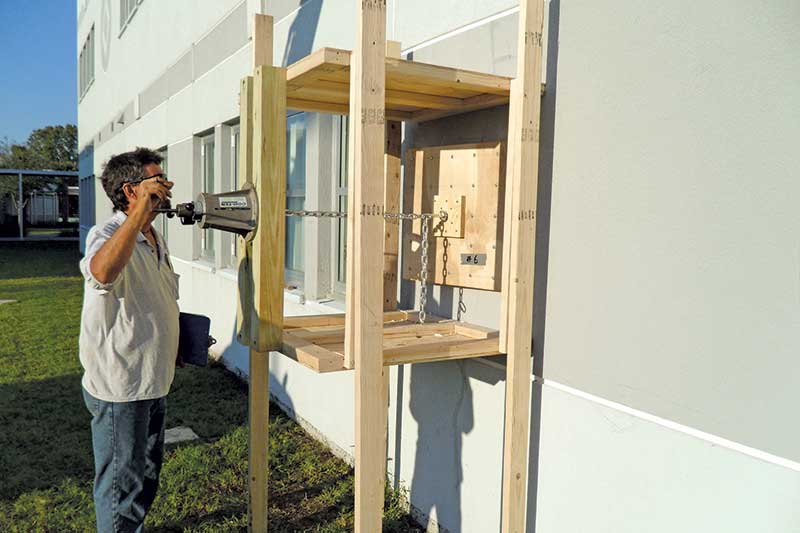
While primarily used equally a tool in direct-practical stucco, pull-off testing tin can be applied to evaluate stucco-over-lath construction. As previously mentioned, the required lath fastener spacing of vii in. on center is a prescriptive requirement that was based on legacy and decades of satisfactory performance. There is no scientific correlation between the required lath fastener spacing and its actual resistance to lateral loads. It is possible, with the new exam method, to correlate a pull-off resistance to the required lath spacing to validate its acceptability, particularly in high-wind regions of the U.s.a..
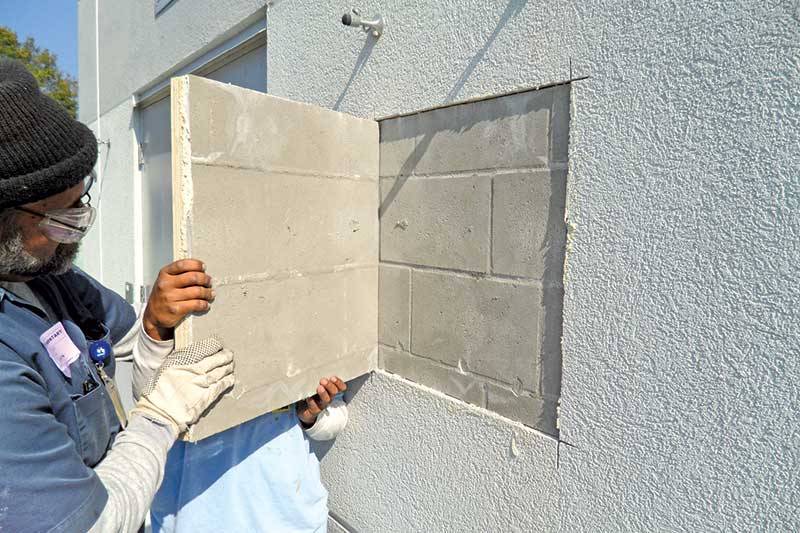
The new ASTM C1860 exam method offers the following key test characteristics:
- The test methods provided in C1860 and described in the following items are suitable for use for both new and existing construction, as well as for both laboratory and field samples.
- The size of test samples is a office of the plaster application. Directly-applied stucco (referred to equally Test Method A in the test method) samples are permitted to be up to 48 in. squared. Considering the prophylactic risks in applying the potential load required to fail a 48-foursquare-in. panel over straight-applied stucco, the exam method allows the user to reduce the test specimen size to six in. squared where geometrical constraints or safety risks apply. In stucco-over-lath construction (referred to as Examination Method B in the test method), test samples are to be 26 in. squared such that the specimen will be centered over two vertical studs spaced either at xvi or 24 in. on center.
- Test samples are to be loaded to failure or to a specified proof load—whichever occurs start.
- Exam samples subject to Test Method A (direct-applied) are to be selected either in random or targeted areas. Proof loads in random and targeted areas are based on a 3-psi and 25-psi bond strength, respectively. The proof load for random areas is less than the proof load in targeted areas because of the inherent bias that is associated with the targeted areas. Testing within targeted areas with known anomalies volition warrant a higher safety gene and higher proof load.
- The proof load for test samples subject to Test Method B (stucco-over-lath) is 3400 pounds, which corresponds to a compatible force per unit area of approximately 5 psi.
- The appendix (non-mandatory information department) of the examination method allows for testing samples to failure where previous testing performed in accordance with the mandatory section of the examination method did non result in failure or where desired by the test specifier. In this scenario, all exam samples are to be 6 in. square.
Within the appendix of the exam method, means to summate a site-specific rubber gene are provided. The site-specific condom gene calculation is based on a statistical analysis that considers the coefficient of variation and standard deviation of the exam data with a selected probability of failure obtained from ASCE 7. Essentially, the more variation within the test information, the more uncertainty and the higher the condom factor.
Information technology is important to notation the new ASTM C1860 examination method does not offer any specifications or instruction on interpreting the data. The test method is simply a way to perform the testing and should not exist misconstrued as an evaluation standard. While it is beyond the scope of the examination method to evaluate the performance of the stucco, the data obtained from the testing can exist used in conjunction with an applied science analysis of plate mechanics to decide the maximum allowable size of stucco delamination that is permitted without supplemental fastening or repair.
 Matthew Innocenzi is principal at Nick Innocenzi & Sons Consulting Engineers and Associates, LLC (NISCEA) in Warrenton, VA. He received both available'south and master's degrees at Virginia Tech and has over nineteen years of experience as an technology consultant. He is an active member of ASTM C11 and D08 committees on Gypsum and Related Building Materials and Prepared Roofing Systems, serving as chairman and technical contact for ASTM C926, Standard Specification on the Application of Portland Cement Based Plaster, and the newly adopted ASTM C1860, Standard Test Methods for Measurement of Tensile Strength or Bond Strength of Portland Cement-Based Plaster by Directly Tension chore groups.
Source: https://iibec.org/stuck-stucco/

Post a Comment for "How to Stick Stucco Back Again"