Spider Man Torment Comic Book Read Online
| "Torment" | |
|---|---|
 | |
| Publisher | Marvel Comics |
| Publication engagement | August – December 1990 |
| Genre |
|
| Title(s) | Spider-Homo #1-five |
| Main character(s) | Spider-Human Lizard Calypso |
| Artistic team | |
| Writer(s) | Todd McFarlane |
| Creative person(s) | Todd McFarlane |
| Letterer(s) | Rick Parker |
| Colorist(s) | Bob Sharen (#1-3) Todd McFarlane (#four) Gregory Wright (#v) |
| Editor(south) | Jim Salicrup |
| Hardcover | ISBN 0-7851-3791-2 |
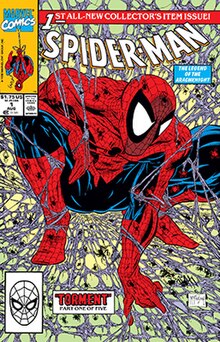
"Torment" is a story arc written past Todd McFarlane that encompassed the first v bug of the new ongoing Spider-Man comic book. It was published in 1990 past Marvel Comics. The comic was a record-breaking sales success and helped start the adjacent stage of development in the Mod Age of Comic Books, which would atomic number 82 to the germination of Prototype Comics and the rise of the speculator market.[1]
Plot synopsis [edit]
The Lizard is going on a murdering spree before Spider-Human tries to stop him.[2] The Lizard poisons Spider-Man and throws him off of a edifice. Information technology is afterward revealed that Calypso is hypnotizing the Lizard to do her behest. Spider-Human being defeats both Calypso and the Lizard, but Spider-Man believes the Cadger died from Calypso'south effect on his brain.[three]
Publication history [edit]
McFarlane had been the artist for The Amazing Spider-Man for a long time, and information technology was for Spider-Man #1 that McFarlane moved to be the artist and the author, even though "the itch, the creative crawling, of writing at the point wasn't and so much that I wanted to exist a author. Because to me, I just wanted to describe. Information technology was being in control of what I was drawing. The only way I was going to get there was to go, 'Well, I accept to brand upward the story.'"[iv]
Editor Jim Salicrup has said it came about organically. He explained, "I encouraged Todd to get more involved and start inking his own piece of work. ... he was such a naturally skilful storyteller, and thinking about everything he was doing. Todd was willing to get off and write backups or do whatsoever he could just to starting writing and learn the whole writing thing. I felt he was so vital to what we were doing with Spider-Man at the time that I found myself doing something I never thought I'd want to practise, which was to add together nonetheless some other Spider-Human being volume".[5]
Function of the thinking was to make more merchandise paperback-friendly stories: "The ongoing Spider-Homo books were similar never-ending soap operas. When they tried to collect stories, they had a problem. And so the thought was to create a new series where we would do six-role self-contained stories that could and so easily be nerveless every bit trade paperbacks"[ description needed ] [vi] They were also inspired past Ballsy to try better paper quality. Curiosity would non introduce it into a current series considering of the increment in price, just if they started a new title they could get alee with their plans.[6]
Reception [edit]
The offset issue sold 2.65 1000000 copies, setting a record at the time. The following year, Rob Liefeld's 10-Forcefulness #one (Baronial 1991) went on to sell 3.9 million, then a couple of months later Jim Lee's X-Men #1 (October 1991) sold vii.five million copies, these sales being driven by heavy use of collector cards and variant covers. Within a year these superstar artists left Marvel to grade Image Comics off the dorsum of the success on these titles, and developments started in these comics led to the speculator boom of the mid-1990s.[1]
However, according to Dave Wallace at Comics Message, "commercial success didn't equate to critical acclaim for McFarlane's new venture, and many found the creative person's attempts at writing to exist clumsy, unsophisticated and pretentious" and that "[t]here was a frequent sense - as with many author-artists - that McFarlane'due south scripts were being written in such a way every bit to give himself something 'cool' to draw, rather than to provide a especially compelling or satisfying story."[vii] The writing was also picked up by Alex Rodrik at Comics Message, who highlighted the lack of consistency in the narration (switching from offset person to third-person), concluding that "Torment is nothing more than than a showcase of Spider-Man'south fluid movement, and while the art is wonderful, pages (at times) are congested and indulgent."[eight] Fifty-fifty for fans of the series at the time the series has not stood the test of fourth dimension. Augie De Blieck Jr. confessed that "[w]hen they get-go came out, I was a mind-numbed McFarlane fan" just reading the trade paperback he constitute that "the money shots of Spidey over the urban center and fighting for his life even so look as energetic and lively equally always, the rest of the pages feel claustrophobic" and that Parker'south lettering was "awful."[9]
McFarlane admitted his first run at writing a series had bug:
by the fourth dimension Spider-Man #ane came out, I'd been in the business concern, 5 years, 6 years, I'd washed hundreds if not thousands of pages of art at that point. I've been able to go the kinks out of my cartoon. While Spider-Man #1 is the beginning of me starting to put kinks on the page writing, which you take to then eventually, like all writers practise, become through. I was in that weird situation on that starting time upshot where, arguably, the worst story I always write is going to be the i that about people bought. Simply I never said I was going to come wholly formed hither. Simply I believe that, equally time went by, ii, three, iv years later, that the writing became adequate at that point, and was ameliorate than the writing in Spider-Man #1.[10]
Nerveless editions [edit]
The series was outset collected as a trade paperback in 1992 and has been reprinted a number of times since:
- Spider-Man: Torment (128 pages, softcover, Marvel Comics, June 1997, ISBN 0-87135-805-0, Boxtree, 96 pages, Dec 1997, ISBN 0-7522-0385-i, hardcover, Marvel Premiere Classic #27, 144 pages, July 2009, ISBN 0-7851-3791-2)
Notes [edit]
- ^ a b Voger (2006) page 55
- ^ Spider-Man #i
- ^ Spider-Man #5
- ^ Voger (2006) folio 57
- ^ Voger (2006) page 61-62
- ^ a b Voger (2006) page 61
- ^ Wallace, David (February 10, 2007). "The Complete Todd McFarlane Spider-Man". Argent Discourse. Comics Bulletin. Retrieved June 15, 2010.
- ^ Rodrik, Alex (March 31, 2010). "Tormented by Spider-Man: Torment". Working Title. Comics Bulletin. Archived from the original on August fourteen, 2012. Retrieved June 14, 2010.
- ^ De Blieck Jr., Augie (June eight, 2001). "Pipeline2, Outcome #102". Comic Book Resources. Retrieved June 15, 2010.
- ^ Fingeroth, Danny (July 31, 2007). "From Write Now #16: The Writin' Side of Me: The Todd McFarlane Interview". Newsarama. Retrieved June xv, 2010. [ permanent dead link ]
References [edit]
- Voger, Mark (2006). The Dark Historic period: Grim, Great & Gimmicky Post-Modern Comics. TwoMorrows Publishing. ISBNone-893905-53-5.
- "Torment" at the Comic Book DB (archived from the original)
External links [edit]
- Spider-Man: Torment at the Curiosity Database Project
- Retro Review: Todd McFarlane'due south 'Torment' at Pink Kryptonite
- Spider-Man: Torment at Rambles: a cultural arts mag
Source: https://en.wikipedia.org/wiki/Torment_%28comics%29

Post a Comment for "Spider Man Torment Comic Book Read Online"