Can I Hit a Laptop Batter With 12 Volts to Spike It Up So It Will Charge Again
How to Notice Happiness With LiFePO4 (Lithium-Ion) Batteries
By: Rob Beckers
You lot have just sold your offset-born into slavery, remortgaged the firm, and bought yourself a lithium-ion bombardment! Now you want to know how to have care of your precious new buy: How to all-time charge lithium-fe batteries, how to discharge them, and how to get the maximum life out of your lithium-ion batteries. This article will explicate the do'southward and don'ts.
Pricing of lithium-ion batteries is slowly changing from obscenely expensive to only moderately unaffordable, and we at Solacity are seeing a steady increment in sales of this type of battery. Virtually users seem to put them to work in RVs, fifth-wheels, campers and like vehicles, while some are going into actual stationary off-grid systems.
This commodity will talk almost one specific category of lithium-ion batteries; Lithium-Iron-Phosphate or LiFePO4 in its chemic formula, also abbreviated equally LFP batteries. These are a little different from what you have in your cell telephone and laptop, those are (by and large) lithium-cobalt batteries. The advantage of LFP is that it is much more than stable, and not prone to self-combustion. That does not hateful the battery cannot combust in example of damage: There is a whole lot of energy stored in a charged battery and in case of an unplanned discharge the results can get very interesting very chop-chop! LFP besides lasts longer in comparison to lithium-cobalt, and is more than temperature-stable. Of all the various lithium battery technologies out in that location this makes LFP all-time suited for deep-bike applications!
Since this seems to be a cause of defoliation for some: All Lithium-Iron-Phosphate batteries are in fact lithium-ion batteries, but not all lithium-ion batteries are Lithium-Atomic number 26-Phosphate batteries. The term "lithium-ion bombardment" is a generic clarification of any bombardment engineering that uses lithium ions to move and store electrical charge. Many chemistries utilize lithium ions to do this, and LiFePO4 is one such specific lithium-ion chemistry.
We will assume the battery has a BMS or Battery Management System, as almost all LFP batteries that are sold as a 12/24/48 Volt pack do. The BMS takes care of protecting the battery; it disconnects the bombardment when it is discharged, or threatens to be over-charged. The BMS also takes care of limiting the charge and discharge currents, monitors cell temperature (and curtails accuse/discharge if needed), and most will balance the cells each time a full charge is done (call back of balancing equally bringing all the cells inside the bombardment pack to the same state-of-accuse, similar to equalizing for a lead-acid battery). Unless you like living on the border, DO NOT BUY a battery without BMS!
What follows below is the knowledge gleamed from reading a large number of Web articles, weblog pages, scientific publications, and discussion with LFP manufacturers. Be careful what yous believe, there is a lot of disinformation out there! While what we write here is by no means meant as the ultimate guide to LFP batteries, our hope is that this article cuts through the bovine excrement and gives solid guidelines to get the most out of your lithium-ion batteries.
The Weak Link - The BMS
We now accept a few years of experience with lithium-ion batteries, and what is becoming clear is that while the LiFePO4 cells hold up very well, that is non the case with the Battery Direction System (BMS). Overall the number of prematurely failed batteries is pocket-size, but with 10,000+ batteries sold it is clear that in 99% of cases it is the BMS that fails, turning the battery into an expensive slice of gender-neutral-cave decoration!
While we very much advocate for using batteries with a build-in BMS (without one the battery would be unsafe and likely fail very quickly!), manufacturers struggle to make their BMS as bullet-proof every bit it should and needs to be. Surge currents due to the input capacitors of big inverters, motors, and air-conditioners can and at times will kill the BMS, rendering the battery useless.
At least i well-known battery manufacturer is now enforcing their warranty conditions to the letter, and that requires the use of an external current limiter when their batteries are used with big inverters ("large" being defined as 3,500 Watt and up). This leads to the ironical situation where the BMS is in that location to protect the bombardment, and now a current limiter gets continued to protect the BMS. What will be side by side to protect the current limiter…
Seeing how the BMS has become the weak link, manufacturers should actually piece of work (difficult) on hardening that. Nothing is 100% bomb-proof, but there certainly is room for comeback! Another solution could be to acknowledge that the BMS is the weak link and make information technology and then it can exist replaced without too much endeavour, for case a gasketed lid on the battery that is removable with a few screws, and a BMS that has connectors and bolted lugs, so a repair shop can bandy the board. It makes no sense to throw away a battery where xc% of the cost is in the cells, and 10% in the BMS, just considering the BMS failed.

Why Lithium-Ion?
We explained in our lead-acrid bombardment article how the Achilles heel of that chemistry is sitting at partial charge for too long. It is too easy to pooch an expensive pb-acrid bombardment banking company in mere months by letting it sit down at partial charge. That is very different for LFP! You can let lithium-ion batteries sit down at partial charge forever without damage. In fact, LFP prefers to sit at partial charge rather than being completely full or empty, and for longevity information technology is amend to bike the battery or to let information technology sit at fractional accuse.
But expect! There is more than!
Lithium-ion batteries are very virtually the holy grail of batteries: With the right charge parameters you tin can almost forget at that place is a battery. At that place is no maintenance. The BMS will take care of it, and yous tin happily cycle abroad!
But wait! There is still more! (Any resemblance with certain infomercials is purely coincidental, and, frankly, nosotros resent the proposition!)…
LFP batteries can likewise final a very long fourth dimension. Our Battle Born LFP batteries are rated at 3000 cycles, at a total 100% charge/discharge cycle. If you lot did that every solar day it makes for over 8 years of cycling! They last fifty-fifty longer when used in less-than-100% cycles, in fact for simplicity you lot tin can use a linear relationship: 50% discharge cycles means twice the cycles, 33% discharge cycles and you lot can reasonably expect three times the cycles.
Merely expect! In that location is more yet!…
A LiFePO4 battery also weighs less than ane/2 of a lead-acid battery of like capacity. It can handle big accuse currents (100% of Ah rating is no problem, effort that with atomic number 82-acrid!), assuasive for rapid charging, it is sealed so at that place are no fumes, and information technology has a very depression self-discharge rate (3% a calendar month or less).
Battery Co$t of Lithium-Ion vs. Lead-Acid
As I am writing this, our Boxing Born 12V 100Ah battery costs $ane,200 Canadian dollars. The total 100Ah is certainly usable, and so that makes 12 10 100 = 1,200 Watt-hr in energy storage, or $ane per Wh in usable energy storage.
Ane of our best-bang-for-the-deep-cycle-cadet lead-acid batteries is the Rolls/Surrette S6 L16-HC (formerly S-550), currently going for $423 for 6V 445Ah in storage. With lead-acrid merely 80% is actually reasonably useful, going into the bottom xx% of energy storage is a recipe for permanent battery impairment, so we have 6 x 445 x 0.viii = 2,136 Wh in free energy storage. That makes for 423 / 2136 = $0.20 per Wh in usable free energy storage.
This is where you say, "look a minute, those d@grand$ lithium batteries are five times the price of lead-acid!!". Immediately followed by "but I nevertheless really want 1!", and right you are: Nosotros did not figure the difference in bombardment life in even so.
The Surrette South-550 is good for effectually 1900 cycles at 50% Depth-Of-Belch (DOD), while the Battle Born volition do 6000 cycles at that aforementioned 50% DOD. That means the lithium-ion battery is going to final most three.2x as long! Over the life of a single fix of LFP batteries the price per usable Wh for lead-acrid now works out to 3.2 10 0.20 = $0.64, simply over half that of lithium-ion! There is more to it than that: In existent life very few people will become the full cycle life out of lead-acid batteries. Information technology is too easy to take them accept offence to your treatment and prematurely depart for the the Big Battery in the Sky. If y'all practice make them go the distance, there is watering, measuring specific gravity, and taking care to regularly recharge them lest they sulfphate. None of that is needed for lithium-ion!
We bet at this signal you are willing to throw in that no-proficient spouse of yours with your first-born just and so you tin can replace your lead-acid with lithium-ion batteries!
Battery Depository financial institution Sizing for LFP
Nosotros hinted at this above: Lithium-ion batteries take 100% usable capacity, while atomic number 82-acid really ends at fourscore%. That means you can size an LFP bombardment bank smaller than a atomic number 82-acid bank, and still have information technology be functionally the same. The numbers suggest that LFP can exist fourscore% the Amp-60 minutes size of lead-acid. There is more to this though.
For longevity atomic number 82-acid bombardment banks should not be sized where they regularly see discharging below 50% SOC. With LFP that is no problem! Circular-trip energy efficiency for LFP is quite a bit better than lead-acid as well, significant that less energy is needed to fill upward the tank afterward a certain level of discharge. That results in faster recovery back to 100%, while we already had a smaller battery bank, reinforcing this effect even more.
The bottom line is that we would exist comfortable to size a lithium-ion battery banking company at 55% – seventy% of the size of an equivalent pb-acid banking concern, and await the same (or meliorate!) performance. Including on those dark wintertime days when sun is in short supply.
Beware of Series Connected Batteries!
There is a potential outcome when multiple lithium-ion batteries are connected in series. For case, two 12 Volt 100 Ah batteries, each with their own build-in BMS, connected in series to brand 24 Volt 100 Ah. At present presume one of those ii batteries is almost-empty, the other pretty full, and you put a load on the batteries, to belch them. The near-empty bombardment volition reach the point where the BMS decides "enough is enough" first and it will switch off that battery, in effect disconnecting your entire battery bank, even though the other battery is however total.
The same potential for trouble exists when charging both batteries at the same time with a 24 Volt charging source. The fuller of the two batteries will fill first, raising the charging Voltage over that battery, until reaching the point where the BMS once again intervenes to protect the battery and switches the full battery off. When the BMS switches off, your entire battery bank "goes away". If both started off uneven, then the other bombardment may well be nowhere near full even so, and this volition not resolve over fourth dimension or multiple charge cycles either.
The moral of this story is that you should understand the dynamics of connecting multiple lithium-ion batteries in series. They do non quite conduct like atomic number 82-acid batteries! Lead-acid batteries volition self-residual when they are charged, all attaining a similar country-of-charge in the end. Lithium-ion batteries due to each having their own independent BMS practice not! From experience we know that by-and-big serial connected batteries, each with their own BMS, can work fine. It would be a good idea though to make sure both are "in sync" every now and and then, past charging them individually with a 12 Volt charger, until both are known to be fully charged, so they start off with the same state-of-charge.
Because information technology is important to understand this, we will come back to information technology and other BMS-related peculiarities in more detail further below.
But Await a Infinitesimal!
Is lithium-ion actually the solution to all our battery woos? Well, non quite…
LFP batteries too have their limitations. A large one is temperature: You cannot accuse a lithium-ion battery below freezing, or zero Centigrade. Atomic number 82-acrid could not care less nigh this. You tin can still discharge the bombardment (at a temporary capacity loss), but charging is not going to happen. The BMS should have care to block charging at freezing temperatures, fugitive accidental damage. This is a Big Deal in our Canadian climate!
Temperature is also an effect at the high end. The biggest single cause of aging of the batteries is use or even but storage at high temperatures. Upwardly to around 30 Centigrade there is no problem. Even 45 Centigrade does not incur too much of a penalization. Anything higher actually accelerates aging and ultimately the end of the bombardment though. This includes storing the battery when it is not existence cycled. We will talk about this in more than detail later, when discussing how LFP batteries fail.
At that place is a sneaky issue that can crop up when using charging sources that potentially provide a high Voltage: When the battery is full the Voltage volition rise, unless the charging source stops charging. If it rises plenty the BMS volition protect the bombardment and disconnect it, leaving that charging source to rise even more! This tin can be an consequence with (bad) car alternator Voltage regulators, that need to always meet a load or the Voltage will fasten and the diodes will release their magic smoke. This tin can too exist an issue with small wind turbines that rely on the battery to keep them under control. They can run away when the battery disappears.
And then there is that steep, steep, initial purchase price!
But we bet you notwithstanding desire i!..
Other BMS-Induced Peculiarities & Issues
The outcome of not being able to accuse LiFePO4 batteries below freezing is beingness overcome past versions that have a build-in heater and a thermostat that senses when the battery is being charged at a low temperature. It volition boot in the heater to get the cells above freezing earlier actually charging the battery (incidentally this is as well how an electric auto works in wintertime).
That is non the but downside of lithium-ion batteries though. There is more yous should be aware of.
The BMS (Bombardment Management System) that is build into the batteries functions as a simple on-off switch, switching the batteries off when Voltage, current, or temperature parameters get to the edge of what is safe. Contrary to what many think, the BMS does non change the charge or discharge current, it actually is just an on-off switch; if you accept a charging source that can push button hundreds of Amps into the battery the BMS will sense this, and switch the battery off when the upper safe limit is reached!
Bound-Starting The BMS
For most conditions (over-current, over-Voltage, under-temperature, or over-temperature) the BMS will automatically switch dorsum on again, either after a prepare amount of fourth dimension has passed, or once the conditions are prophylactic. Still, there is 1 case where the BMS volition Not switch on by itself, the bombardment will stay off: When whatsoever cell within a LFP battery falls below the lower rubber Voltage limit the BMS will switch off to protect the cells from over-belch. It does this with still a picayune accuse left in the cells, so the battery can sit down for a while and cocky-discharge before damage to the cells occurs. The important part is that the BMS volition not switch the bombardment dorsum on past itself! When this happens the battery merely "goes away" and produces 0 Volt.
To make the BMS switch on once again afterward a depression-Voltage disconnect result the battery needs to see a charging Voltage. How much exactly varies from brand-to-brand, merely by and large this means fourteen.0 Volt or up (for a 12V battery). Keep in heed that inverter-chargers won't work without a bombardment, nor will solar charge controllers. They demand to see regular battery Voltage to part. That ways you cannot switch the battery BMS back on by charging from a generator (via your inverter-charger) or your solar panels. To make the BMS switch on again you either need a 120V Air conditioning charger that tin can practise "dead battery charging" equally it is unremarkably called in the brochure, meaning it puts out a charging Voltage even if it does not sense a battery. Alternatively you can "jump start" the switched-off battery past taking another battery of the same nominal Voltage, even a lead-acrid battery, and connect it in parallel with the expressionless battery, and then charge via solar or your inverter-charger. As soon equally the Voltage reaches high enough the BMS will sense it and switch the battery back on again. At that signal you tin disconnect the extra battery, but delight go on charging so the empty battery does not immediately switch off once more with the slightest load.
Residual & BMS
Some other source of confusion, and potential problems, is when multiple single lithium-ion batteries, each with their own BMS, get connected in series to create a battery banking concern with a higher Voltage. For example, past connecting four 12 Volt batteries in series to create a 48V battery bank. Lithium-ion batteries do non at all cocky-residuum! This is very different from pb-acid, where charging gets progressively less efficient equally the bombardment gets more fully charged; this makes it so when multiple batteries are connected in series the ones that have less charge in them will automatically "catch up" to the fuller battery. Non so for lithium-ion batteries! Whatsoever difference in accuse betwixt series-connected batteries will persist from charge-cycle to charge-cycle and wreak havoc: Say a half-full 12V battery is connected to a fully charged 12V bombardment, in series, to create a 24V bombardment banking company. When discharging the half-full battery volition achieve empty first, and at some point the BMS volition intervene and switch that bombardment off, causing the unabridged bombardment depository financial institution to "go away". Moreover, the empty bombardment will non switch on over again until it sees a charging Voltage. The 2d battery will at this point exist nearly half full, and if the entire bank is charged in this state the situation will be exactly the same as before; one bombardment will reach full while the other is only merely one-half-total. Worse still, the fully charged battery volition continue to rising in Voltage until the BMS intervenes and switches that battery off, causing the entire banking concern one time over again to just disappear (though information technology volition switch back on again by itself, not needing a "jump kickoff"). This situation will persist forever, unless manually corrected.
Victron Battery Balancer
Victron makes a product that can help rest multiple serial-connected 12 Volt lithium-ion batteries. Their Battery Balancer measures the Voltage of each 12V bombardment during charging, and bypasses one Amp of the battery with the higher Voltage, to the battery with the lower Voltage, until they are equal. It takes one Battery Balancer for a 24 Volt battery banking concern, two for a 36 Volt bank, and three for a 48 Volt banking company.
That means you lot HAVE to brand sure that all batteries are at the aforementioned State-Of-Accuse (SOH) earlier connecting lithium-ion batteries in series! The easiest way to ensure this is by fully 100% charging each battery before they are connected in series. For a set of 12V batteries that means (for example) using a 120V Air-conditioning charger plugged into the grid or a generator, gear up information technology to an absorb Voltage of fourteen.4V, and let it charge until no more than current goes into the battery. Repeat this for each bombardment, and but so connect them serial. Depending on how well they friction match this may demand to exist repeated every at present and then (once a twelvemonth or so) though reports are encouraging that a group of series-connected batteries will go on to behave well over time, every bit long every bit they started out at the same SOH.
Note that this is only a cistron for series-continued lithium-ion batteries. Parallel-connected batteries do not accept this issue, they all run across the same Voltage and eventually will arrive at the same SOH.
It is normal for series continued lithium-ion batteries to each have a slightly different Voltage (fifty-fifty if they are at the aforementioned SOH), and because the BMS will switch off batteries that exceed an upper rubber value, it is a good idea to ready any charging sources in the system to use the lower limit for the bulk-absorb Voltage that will yet fill the battery. A good value would be 14.0 Volt, with a 1-hour blot time (on a 12V basis, multiply as needed). That will hopefully forestall any individual battery from rising above the upper cut-off limit. If this still causes the BMS of one or more batteries to intervene, try a lower blot-time value such as 1/two hour. If needed absorb time tin be gear up all the way down to cipher (or equally depression as settings let), by the time a LiFePO4 battery reaches 14.0V information technology is already at least 95% full.
BMS Induced Power Limits
Unlike pb-acid batteries that can (briefly) deliver hundreds and even grand+ Amps in current, there is a difficult limit to what the BMS in a lithium-ion battery volition allow. There usually are several stages; this much for a fraction of a second, that much for a few seconds, and some lower limit for long periods of time. Exceeding those limits ways the BMS will switch off, and the battery "goes away". This affects the loads you tin bolt onto a lithium-ion battery.
The typical 12 Volt 100 Ah battery would, for example, have a limit of 100 Amp continuous output electric current. That translates to (roughly) 12 x 100 = i,200 Watt. Connect a iv,000 Watt inverter and you are guaranteed to never attain that level of output power! After 1,200 Watt the BMS volition intervene and switch the battery off. It would take at to the lowest degree 4 of these batteries to exist able to drive an inverter of this size and actually accomplish total continuous output!
Besides continuous output limits, in that location is a more insidious issue: Inverters have input capacitors on the battery side, to polish out and handle surges in output ability on the AC side. Large inverters have large input capacitors, and large capacitors cause very large currents to menstruum when they are connected to the battery. For large inverters, effectually 3 kW and up, this tin can easily reach in the hundreds of Amps! While most lithium-ion batteries have a big limit for cursory surges, this capacitor charge-up current can still exceed that limit, causing the BMS to switch the battery off. To brand it possible to even connect these large inverters, the input capacitors need a adventure to slowly charge up, and to practice that a 4.7 kOhm v Watt resistor can be connected over a switch or billow in line with the positive wire betwixt battery depository financial institution and inverter. The resistor makes information technology then a little current flows into the inverter, slowly charging the capacitors, and by the time the switch or breaker is moved to the "on" position they are already charged up and in that location is no large electric current surge.
While it is important to understand the above in case problems ascend, in practice we have institute lithium-ion batteries to deport quite well. Fifty-fifty when connected in serial. Merely follow the guidelines we merely talked about and you lot will likely exist just fine!
How Does a LiFePO4 Battery Work?
LiFePO4 Internal Structure
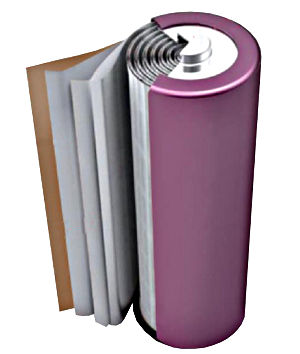
Lithium-ion batteries are referred to as a blazon of 'rocking-chair' battery: They motion ions, in this instance lithium ions, from the negative to the positive electrode when discharging, and dorsum again when charging. The drawing on the right shows what is going on inside. The little ruby balls are the lithium ions, that motility back and forth between the negative and positive electrodes.
On the left side is the positive electrode, constructed from lithium-atomic number 26-phosphate (LiFePO4). This should help explicate the name of this blazon of bombardment! The iron and phosphate ions course a grid that loosely trap the lithium ions. When the cell is getting charged, those lithium ions go pulled through the membrane in the heart, to the negative electrode on the right. The membrane is made of a blazon of polymer (plastic), with lots of tiny trivial pores in it, making it piece of cake for the lithium ions to laissez passer through. On the negative side we discover a lattice made of carbon atoms, that tin trap and agree those lithium ions that cross over.
Discharging the battery does the same affair in opposite: As electrons period away through the negative electrode, the lithium ions one time again proceed the move, through the membrane, back to the fe-phosphate lattice. They are once again stored on the positive side until the battery gets charged again.
If you lot have actually been paying attention you at present understand that the battery drawing on the correct shows an LFP battery that is most completely discharged. Near all the lithium ions are on the side of the positive electrode. A fully charged battery would have those lithium ions all stored inside the carbon of the negative electrode.
In the real world lithium-ion cells are congenital of very thin layers of alternating aluminum – polymer – copper foils, with the chemicals pasted on them. Often they are rolled up like a jelly-whorl, and put in a steel canister, much like an AA bombardment. The 12 Volt lithium-ion batteries you buy are made of many of those cells, continued in serial & parallel to increment the Voltage and Amp-60 minutes capacity. Each cell is around 3.3 Volt, then 4 of them in series makes 13.ii Volt. That is only the right Voltage for replacing a 12 Volt lead-acid battery!
Charging an LFP Battery
Most regular solar accuse controllers have no trouble charging lithium-ion batteries. The Voltages needed are very similar to those used for AGM batteries (a blazon of sealed pb-acid bombardment). The BMS helps too, in making sure the battery cells see the correct Voltage, do not become overcharged, or overly-discharged, it balances the cells, and ensures the prison cell temperature is within reason while they are being charged.
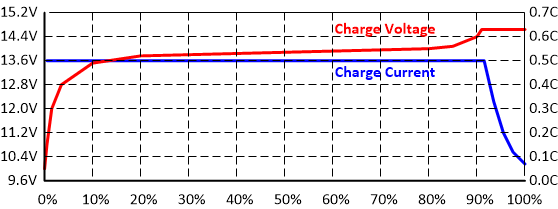
The graph below shows a typical contour of a LiFePO4 battery getting charged. To brand information technology easier to read the Voltages take been converted to what a 12 Volt LFP battery pack would come across (4x the single-cell Voltage).
LiFePO4 Charge Voltage vs. SOC
Shown in the graph is a charge rate of 0.5C, or half of the Ah capacity, in other words for a 100Ah battery this would be a charge charge per unit of l Amp. The charge Voltage (in reddish) will non really change much for college or lower charge rates (in blue), LFP batteries accept a very apartment Voltage bend.
Lithium-ion batteries are charged in two stages: Outset the current is kept abiding, or with solar PV that generally means that we try and send equally much current into the batteries as available from the sun. The Voltage will slowly ascent during this fourth dimension, until it reaches the 'absorb' Voltage, 14.6V in the graph above. Once absorb is reached the battery is about 90% full, and to fill it the rest of the way the Voltage is kept constant while the electric current slowly tapers off. In one case the electric current drops to around 5% – ten% of the Ah rating of the battery it is at 100% State-Of-Accuse.
In many means a lithium-ion battery is easier to accuse than a lead-acid bombardment: Equally long as the charge Voltage is loftier plenty to move ions it charges. Lithium-ion batteries do not care if they are non fully 100% charged, in fact they last longer if they are not. There is no sulphating, there is no equalizing, the absorb time does non really matter, you cannot actually overcharge the bombardment, and the BMS takes care of keeping things within reasonable boundaries.
Charge Voltage Needed
And then what Voltage is enough to get those ions moving? A little experimenting shows that 13.6 Volt (3.4V per cell) is the cut-off betoken; below that very little happens, while to a higher place that the battery will go at least 95% full given enough time. At 14.0 Volt (3.5V per prison cell) the battery easily charges upwardly to 95+ percentage with a few hours absorb fourth dimension and for all intents and purposes there is little deviation in charging between xiv.0 or higher Voltages, things just happen a little faster at 14.2 Volt and above.
Lithium-ion cell structure
Bulk/Absorb Voltage
To summarize this, a bulk/blot setting between fourteen.2 and 14.6 Volt will piece of work great for LiFePO4! Lower is possible too, down to most fourteen.0 Volt, with the help of some absorb time. Slightly college Voltages are possible, the BMS for most batteries will allow effectually fourteen.8 – 15.0 Volt before disconnecting the bombardment. In that location is no benefit to a higher Voltage though, and more hazard of getting cut of past the BMS, and possibly impairment.
Bladder Voltage
LFP batteries practice not demand to be floated. Charge controllers have this because lead-acid batteries have such a loftier rate of self-discharge that it makes sense to proceed trickling in more than charge to proceed them happy. For lithium-ion batteries it is non great if the battery constantly sits at a high State-Of-Charge, and then if your accuse controller cannot disable bladder, just set up it to a depression enough Voltage that no actual charging will happen. Whatsoever Voltage of 13.six Volt or less will do.
Equalize Voltage
With accuse Voltages over xiv.6 Volt actively discouraged, it should exist clear that no equalize should exist done to a lithium-ion battery! If equalize cannot be disabled, set information technology to 14.6V or less, then information technology becomes simply a regular absorb charge cycle.
Absorb Fourth dimension
There is a lot to exist said for simply setting the absorb Voltage to 14.4V or fourteen.6V, and then only finish charging once the battery reaches that Voltage! In brusk, zero (or a short) absorb fourth dimension. At that point your battery will exist around 90% total. LiFePO4 batteries will be happier in the long run when they do not sit at 100% SOC for too long, and so this practice will extend battery life. If you admittedly have to have 100% SOC in your battery and then absorb will do that! Officially this is reached when the charge electric current drops to five% – ten% of the Ah rating of the bombardment, so five – ten Amp for a 100Ah bombardment. If you cannot stop absorb based on current, then set blot fourth dimension to about 2 hours and call information technology a day.
Temperature Compensation
LiFePO4 batteries practise not need temperature compensation! Delight switch this off in your charge controller, or your charge Voltage will exist wildly off when it is very warm or cold.
Be certain to check your charge controller Voltage settings against those really measured with a skilful quality digital multi-meter! Small changes in Voltage tin can have a big impact when charging a lithium-ion bombardment! Change the charge settings accordingly!
Discharging an LFP Battery
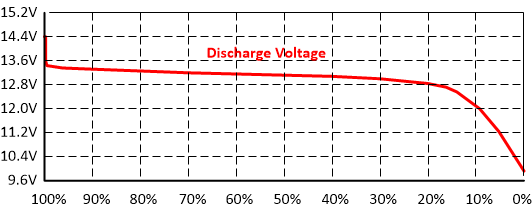
Dissimilar lead-acid batteries, the Voltage of a lithium-ion battery stays very constant during discharge. That makes it difficult to divine the Country-Of-Accuse from Voltage alone. For a battery with a moderate load the discharge bend looks as follows.
LiFePO4 Discharge Voltage vs. SOC
Virtually of the time during discharge, the battery Voltage will exist right around 13.ii Volt. Information technology varies by just 0.two Volt all the way from 99% to xxx% SOC. Not long ago information technology was a Very Bad Idea™ to go below twenty% SOC for a LiFePO4 battery. That has changed, and the current crop of LFP batteries will quite merrily discharge all the way down to 0% for many cycles. Nevertheless, there is benefit in cycling less deep. Information technology is not just that cycling to 30% SOC will get you one/3 more cycles vs. cycling down to 0%, your battery volition likely live for more than cycles than that. Hard numbers are, well, difficult to come up by, only cycling downwards to 50% SOC seems to show around 3x the cycle life vs. cycling 100%.
Below is a tabular array that shows battery Voltage for a 12 Volt battery pack vs. Depth-Of-Discharge. Take these Voltage values with a grain of salt, the belch curve is so flat that it actually is hard to determine SOC from Voltage alone. Small variations in load, and accuracy of the Volt meter, will throw off the measurement.
| State-Of-Charge | Voltage at rest (zilch current) | Voltage under load (0.25C) |
|---|---|---|
| 100% | 14.0 Volt | 13.6 Volt |
| 99% | 13.8 Volt | 13.4 Volt |
| 90% | 13.four Volt | 13.three Volt |
| 70% | 13.2 Volt | 13.2 Volt |
| 40% | xiii.ii Volt | thirteen.1 Volt |
| 30% | thirteen.0 Volt | 13.0 Volt |
| 20% | 12.9 Volt | 12.9 Volt |
| 17% | 12.8 Volt | 12.8 Volt |
| fourteen% | 12.half dozen Volt | 12.5 Volt |
| nine% | 12.4 Volt | 12.0 Volt |
| 0% | x.4 Volt | 10.0 Volt |
Storing Lithium-Ion Batteries
The very low self-discharge rate makes it like shooting fish in a barrel to shop LFP batteries, even for longer periods. Information technology is no trouble to put a lithium-ion battery abroad for a year, just make sure at that place is some charge in it before placing it in storage. Something between 50% – 60% is platonic, that volition give the battery a very long time earlier cocky-discharge brings the Voltage shut to the danger point.
Storing batteries below freezing is fine, even at very low temperatures such as -40 Centigrade (that is the aforementioned in Fahrenheit), or even less! The electrolyte in LiFePO4 cells does not contain whatever water, then even when it freezes (which happens around -forty Centigrade, depending on the particular formulation) it does non expand, and does not impairment the cells. Just let the bombardment warm upwardly a bit before you start discharging it again, which is OK at -20 Centigrade and above. You will see an apparent loss of capacity when discharging at below-freezing temperatures that reverses when the bombardment gets above freezing, and in that location is a slightly accelerated effect on crumbling. Storing them at low temperatures is certainly much ameliorate than storage at loftier temperatures: Calendar aging slows down dramatically at low temperatures. Try to avoid storing them at 45 Centigrade and above, and try to avoid storing them completely full if possible (or nearly empty).
If y'all need to shop batteries for longer periods, be sure to but disconnect all wires from them. That manner there tin can not exist whatsoever stray loads that slowly discharge the batteries.
The End of Your Lithium-Ion Batteries
We hear you gasp in horror; the idea of your precious LFP battery depository financial institution existence no longer sends shivers down your spine! Alas, all good things eventually must come up to an finish. What we want to forbid is an end of the premature (and possibly spectacular) kind, and to do that we have to sympathize how lithium-ion batteries die.
Battery manufacturers consider a battery "dead" when its chapters falls to 80% of what it should be. So, for a 100Ah battery, its stop comes when its capacity is down to 80Ah. There are ii mechanisms at piece of work towards the demise of your battery: Cycling and aging. Each time you discharge and recharge the battery it does a niggling bit of damage, and you loose a piddling bit of capacity. But even if you lot put your precious battery in a beautiful glass-enclosed shrine, never to exist cycled, it volition still come to an stop. That final ane is chosen calendar life.
It is hard to find hard data on calendar life for LiFePO4 batteries, very little is out there. Some scientific studies were washed on the effect of extremes (in temperature, and SOC) on agenda life, and those help ready limits. What nosotros gather is that if you do not abuse your battery bank, avert extremes, and more often than not merely use your batteries within reasonable bounds, there is an upper limit of effectually 20 years on calendar life.
Besides the cells within the bombardment, there is as well the BMS, which is fabricated out of electronic parts. When the BMS fails, and then will your battery. Lithium-ion batteries with a build-in BMS are withal likewise new, and nosotros will have to see, but ultimately the Battery Management Organisation has to survive for every bit long as the lithium-ion cells do too.
Processes inside the battery conspire over time to coat the purlieus layer betwixt electrodes and electrolyte with chemical compounds that forestall the lithium ions from entering and leaving the electrodes. Processes likewise demark lithium ions into new chemical compounds, so they are no longer available to motion from electrode to electrode. Those processes volition happen no matter what we do, simply they are very much dependent on temperature! Keep your batteries under 30 Centigrade and they are very tedious. Go over 45 Centigrade and things speed up considerably! Public enemy no. 1 for lithium-ion batteries, by far, is estrus!
There is more to calendar life and how quickly a LiFePO4 bombardment will historic period: Land-Of-Charge has something to do with it every bit well. While high temperatures are bad, these batteries really, really exercise not similar to sit at 0% SOC and very high temperatures! As well bad, though non quite as bad as 0% SOC, is for them to sit at 100% SOC and high temperatures. Very low temperatures have less of an result. As we discussed, y'all cannot (and the BMS will not let y'all) charge LFP batteries below freezing. As it turns out, discharging them below freezing, while possible, does have an accelerated result on aging equally well. Nowhere near as bad as letting your battery sit down at a high temperature, but if you are going to discipline your battery to freezing temperatures it is meliorate to practice so while it is neither charging nor discharging, and with some gas in the tank (though not a full tank). In a more general sense, information technology is better to put away these batteries at around fifty% – 60% SOC if they need longer-term storage.
If yous really want to know, what happens when a lithium-ion battery gets charged below freezing is that metallic lithium is deposited on the negative (carbon) electrode. Not in a dainty mode either, it grows in abrupt, needle-similar structures, that somewhen puncture the membrane and short out the battery (leading to a spectacular Rapid Unscheduled Disassembly Event every bit NASA calls it, involving smoke, extreme heat, and quite maybe flames as well). Lucky for u.s., this is something the BMS prevents from happening.
Nosotros are moving on to cycle life. Information technology has become common to get thousands of cycles, even at a full 100% charge-belch bicycle, out of lithium-ion batteries. In that location are some things you can practice though to maximize bicycle life.
We talked about how LiFePO4 batteries work: They move lithium ions betwixt the electrodes. It is important to understand that these are actual, physical particles, that take a size to them. They are yanked out of one electrode and stuffed into the other, each fourth dimension you accuse-discharge the battery. This causes harm, in detail to the carbon of the negative electrode. Each fourth dimension the battery gets charged the electrode swells a scrap, and each belch it slims down again. Over time that causes microscopic cracks. It is because of this that charging to a little below 100% will requite yous more cycles, as volition discharging to a little above 0%. Also, think of those ions as exerting "pressure", and farthermost State-Of-Accuse numbers exert more than pressure, causing chemical reactions that are non to the benefit of the battery. That is why LFP batteries do not similar to be put away at 100% SOC, or put into bladder-charging at (most) 100%.
How fast those lithium ions get yanked hither and yon has an effect on cycle life as well. In lite of the above that should be no surprise. While LFP batteries will routinely do charging and discharging at 1C (i.e. 100 Amp for a 100Ah bombardment), you will see more cycles out of your battery if you limit this to more reasonable values. Lead-acrid batteries have a limit of effectually 20% of Ah rating, and staying within this for lithium-ion will have benefits for a longer battery life likewise.
The last gene worth mentioning is Voltage, though this is really what the BMS is designed to keep in cheque. Lithium-ion batteries have a narrow Voltage window, for both charging and discharging. Going outside that window very apace results in permanent harm, and on the loftier stop a possible RUD Effect (NASA-talk, as mentioned before). For LiFePO4 that window is well-nigh 8.0V (ii.0V per cell) to sixteen.8 Volt (4.2V per cell). The build-in BMS should accept intendance to continue the battery well within those limits.
Accept-Dwelling Lessons
Now that we know how lithium-ion batteries work, what they similar and dislike, and how they ultimately fail, there are some pointers to take abroad. Nosotros have made a piffling listing beneath. If y'all are going to do nothing else, please take note of the first two, they accept by far the most outcome on the overall fourth dimension you lot will get to enjoy your lithium-ion battery! Taking heed of the others will help too, to make your battery terminal even longer.
To sum up, for long and happy LFP battery life, in order of importance, yous should be mindful of the following:
- Keep the battery temperature under 45 Centigrade (under 30C if possible) – This is by far the well-nigh of import!!
- Proceed accuse and discharge currents under 0.5C (0.2C preferred)
- Keep battery temperature to a higher place 0 Centigrade when discharging if possible – This, and everything below, is nowhere near every bit important equally the outset 2
- Do non cycle beneath 10% – 15% SOC unless yous really need to
- Do not float the battery at 100% SOC if possible
- Do not accuse to 100% SOC if you do not need information technology
That is it! Now you too can find happiness and a fullfilling life with your LiFePO4 batteries!
Source: https://www.solacity.com/how-to-keep-lifepo4-lithium-ion-batteries-happy/

Post a Comment for "Can I Hit a Laptop Batter With 12 Volts to Spike It Up So It Will Charge Again"