When Were Wmoen Allowed to Act in Kabuki Again


Onoe Kikugorō VI every bit Umeō-maru in Sugawara Denju Tenarai Kagami .
Kabuki ( 歌舞伎 ) is a classical form of Japanese dance-drama. Kabuki theatre is known for its heavily-stylised performances, the ofttimes-glamorous costumes worn by performers, and for the elaborate kumadori brand-up worn past some of its performers.
Kabuki is thought to have originated in the very early on Edo period, when founder Izumo no Okuni formed a female dance troupe who performed dances and low-cal sketches in Kyoto. The art grade subsequently developed into its present all-male theatrical form after women were banned from performing in kabuki theatre in 1629. Kabuki developed throughout the late 17th century and reached its zenith in the mid-18th century.
In 2005, kabuki theatre was proclaimed by UNESCO every bit an intangible heritage possessing outstanding universal value. In 2008, information technology was inscribed in the UNESCO Representative List of the Intangible Cultural Heritage of Humanity.[i]
Etymology [edit]
The private kanji that make upwards the give-and-take kabuki tin be read as "sing" ( 歌 ), "dance" ( 舞 ), and "skill" ( 伎 ). Kabuki is therefore sometimes translated as "the art of singing and dancing". These are, however, ateji characters which practise not reflect actual etymology. The kanji of "skill" more often than not refers to a performer in kabuki theatre.
Since the word kabuki is believed to derive from the verb kabuku , meaning "to lean" or "to be out of the ordinary", the word kabuki tin can also be interpreted as "advanced" or "bizarre" theatre.[2] The expression kabukimono ( 歌舞伎者 ) referred originally to those who were bizarrely dressed. It is often translated into English language equally "foreign things" or "the crazy ones", and referred to the style of wearing apparel worn by gangs of samurai.
History [edit]
1603–1629: Female kabuki [edit]

The earliest portrait of Izumo no Okuni, the founder of kabuki (1600s)
The history of kabuki began in 1603 when Izumo no Okuni, possibly a miko of Izumo-taisha, began performing with a troupe of female person dancers a new style of trip the light fantastic drama, on a makeshift stage in the dry bed of the Kamo River in Kyoto,[3] [4] at the very outset of the Edo period, and Nippon's rule by the Tokugawa shogunate, enforced by Tokugawa Ieyasu.[5]
In the earliest forms of kabuki, female performers played both men and women in comic playlets about ordinary life. It didn't have long for the way to get pop, and Okuni was asked to perform earlier the Imperial Court. In the wake of such success, rival troupes rapidly formed, and kabuki was built-in equally ensemble dance and drama performed by women.
Much of the appeal of kabuki in this era was due to the ribald, suggestive themes featured by many troupes; this appeal was further augmented past the fact that many performers were also involved in prostitution.[2] For this reason, kabuki was likewise known as "prostitute kabuki" ( 遊女歌舞妓 ) during this period.[ commendation needed ]
Kabuki became a common form of entertainment in the red-light districts of Japan, especially in Yoshiwara,[6] the registered crimson-lite district in Edo. The widespread appeal of kabuki often meant that a diverse crowd of dissimilar social classes gathered to watch performances, a unique occurrence that happened nowhere else in the urban center of Edo. Kabuki theatres became well known every bit a place to both encounter and be seen in terms of manner and mode, as the audition—commonly comprising a number of socially low merely economically wealthy merchants—typically used a functioning as a mode to feature the fashion trends.
Equally an art-form, kabuki also provided inventive new forms of entertainment, featuring new musical styles played on the shamisen , clothes and fashion often dramatic in advent, famous actors and stories often intended to mirror current events. Performances typically lasted from morning until sunset, with surrounding teahouses providing meals, refreshments and identify to socialise. The expanse surrounding kabuki theatres too featured a number of shops selling kabuki souvenirs.
Despite its popularity, the ruling shogunate held unfavorable views of kabuki performances. The oversupply at a kabuki performance often mixed different social classes, and the social peacocking of the merchant classes, who controlled much of Japan's economy at the fourth dimension, were perceived to have entrenched upon the standing of the samurai classes, both in appearance and frequently wealth. In an effort to clamp down on kabuki'southward popularity, women's kabuki, known as onna-kabuki , was banned in 1629 for existence as well erotic.[seven] Following this ban, young boys began performing in wakashū-kabuki , which was besides shortly banned.[7] Kabuki switched to adult male actors, called yaro-kabuki , in the mid-1600s.[eight] Adult male actors, however, connected to play both female and male characters, and kabuki retained its popularity, remaining a central attribute of the Edo period urban life-style.
Although kabuki was performed widely across Nihon, the Nakamura-za, Ichimura-za and Kawarazaki-za theatres became the almost widely known and popular kabuki theatres, where some of the most successful kabuki performances were and still are held.[v]
1629–1673: Transition to yarō-kabuki [edit]
During the fourth dimension flow of 1628–1673, the mod version of all-male kabuki actors, a style of kabuki known every bit yarō-kabuki (lit., "young homo kabuki"), was established, following the ban on women and immature boys. Cross-dressing male actors, known as " onnagata " (lit., "woman role") or " oyama " took over previously female person- or wakashu -acted roles. Young (adolescent) men were yet preferred for women'due south roles due to their less obviously masculine appearance and the higher pitch of their voices. The roles of adolescent men in kabuki, known as wakashu , were too played by young men, often selected for their attractiveness; this became a common practise, and wakashu were often presented in an erotic context.[9]
The focus of kabuki performances also increasingly began to emphasise drama alongside dance. However, the ribald nature of kabuki performances connected, with male actors also engaging in sexual practice work for both female and male person customers. Audiences ofttimes became rowdy, and brawls occasionally broke out, sometimes over the favors of a peculiarly popular or handsome actor, leading the shogunate to ban commencement onnagata so wakashū roles for a brusk period of time; both bans were rescinded by 1652.[10]
1673–1841: Genroku period kabuki [edit]

Oniji Ōtani III (Nakazō Nakamura II) every bit Edobee in the May 1794 product of Koi Nyōbo Somewake Tazuna

Kabuki actors Bando Zenji and Sawamura Yodogoro; 1794, fifth month past Sharaku
During the Genroku period, kabuki thrived, with the construction of kabuki plays formalising into the construction they are performed in today, alongside many other elements which eventually came to be recognised as a primal aspect of kabuki tradition, such as conventional character tropes. Kabuki theater and ningyō jōruri , an elaborate grade of boob theater later known as bunraku , became closely associated with each other, mutually influencing the other's further evolution.
The famous playwright Chikamatsu Monzaemon, one of the first professional kabuki playwrights, produced several influential works during this fourth dimension, though the piece usually acknowledged as his most pregnant, Sonezaki Shinjū (The Beloved Suicides at Sonezaki ), was originally written for bunraku . Like many bunraku plays, information technology was adjusted for kabuki, somewhen becoming popular enough to reportedly inspire a number of real-life "copycat" suicides, and leading to a regime ban on shinju mono (plays about beloved suicides) in 1723.
Likewise during the Genroku period was the development of the mie style of posing, credited to kabuki actor Ichikawa Danjūrō I,[11] alongside the evolution of the mask-like kumadori makeup worn by kabuki actors in some plays.[12]
In the mid-18th century, kabuki fell out of favor for a time, with bunraku taking its place as the premier form of stage entertainment amongst the lower social classes. This occurred partly considering of the emergence of several skilled bunraku playwrights in that fourth dimension. Little of annotation would occur in the farther development of kabuki until the finish of the century, when it began to reemerge in popularity.
1842–1868: Saruwaka-chō kabuki [edit]

In the 1840s, repeated periods of drought led to a series of fires affecting Edo, with kabuki theatres—traditionally made of wood—frequently called-for downwardly, forcing many to relocate. When the area that housed the Nakamura-za was completely destroyed in 1841, the shōgun refused to let the theatre to be rebuilt, maxim that information technology was against burn lawmaking.[8]
The shogunate, more often than not disapproving of the socialisation and trade that occurred in kabuki theatres between merchants, actors and prostitutes, took reward of the burn crisis in the post-obit twelvemonth, forcing the Nakamura-za, Ichimura-za and Kawarazaki-za out of the urban center limits and into Asakusa, a northern suburb of Edo. This was function of the larger Tenpō Reforms that the shogunate instituted starting in 1842 to restrict the overindulgence of pleasures.[13] Actors, stagehands, and others associated with the performances were also forced to move in lieu of the death of their livelihood; despite the move of everyone involved in kabuki operation, and many in the surrounding areas, to the new location of the theatres, the inconvenience of the distance led to a reduction in attendance.[five] These factors, along with strict regulations, pushed much of kabuki "underground" in Edo, with performances changing locations to avoid the government.
The theatres' new location was called Saruwaka-chō, or Saruwaka-machi; the last xxx years of the Tokugawa shogunate'south rule is often referred to as the "Saruwaka-machi period", and is well known for having produced some of the most exaggerated kabuki in Japanese history.[5]
Saruwaka-machi became the new theatre commune for the Nakamura-za, Ichimura-za and Kawarazaki-za theatres. The district was located on the main street of Asakusa, which ran through the middle of the small urban center. The street was renamed after Saruwaka Kanzaburo, who initiated Edo kabuki in the Nakamura-za in 1624.[5]
European artists began noticing Japanese theatrical performances and artwork, and many artists, such as Claude Monet, were inspired by Japanese woodblock prints. This Western interest prompted Japanese artists to increase their depictions of daily life, including the depiction of theatres, brothels, main streets then on. One artist, Utagawa Hiroshige, produced a series of prints based on Saruwaka from the Saruwaka-machi period in Asakusa.[five]
Despite the revival of kabuki in another location, the relocation diminished the tradition's most abundant inspirations for costuming, make-upwardly, and storylines. Ichikawa Kodanji4 was considered one of the most active and successful actors during the Saruwaka-machi period. Deemed unattractive, he mainly performed buyō , or dancing, in dramas written by Kawatake Mokuami, who also wrote during the Meiji era to follow.[5] Kawatake Mokuami commonly wrote plays that depicted the mutual lives of the people of Edo. He introduced shichigo-cho (seven-and-five syllable meter) dialogue and music such equally kiyomoto .[5] His kabuki performances became quite popular once the Saruwaka-machi catamenia concluded and theatre returned to Edo; many of his works are still performed.
In 1868, the Tokugawa ceased to exist, with the restoration of the Emperor. Emperor Meiji was restored to power and moved from Kyoto to the new capital of Edo, or Tokyo, beginning the Meiji menstruation.[8] Kabuki once more returned to the pleasance quarters of Edo, and throughout the Meiji period became increasingly more than radical, as modern styles of kabuki plays and performances emerged. Playwrights experimented with the introduction of new genres to kabuki, and introduced twists on traditional stories.
Post-Meiji catamenia kabuki [edit]

Beginning in 1868, enormous cultural changes, such as the fall of the Tokugawa shogunate, the emptying of the samurai grade, and the opening of Japan to the West, helped to spark kabuki's re-emergence. Both actors and playwrights strove to improve the reputation of kabuki in the face of new foreign influence and amongst the upper classes, partially through adapting traditional styles to modern tastes. This attempt would prove successful, with the Emperor sponsoring a kabuki performance on 21 April 1887.[14]
Afterwards World War II, the occupying forces briefly banned kabuki, which had formed a potent base of operations of support for Japan's war efforts since 1931.[15] This ban was in conjunction with broader restrictions on media and fine art forms that the American armed forces occupation instituted after WWII.[16] However, past 1947 the ban on kabuki was rescinded, just censorship rules lingered.[17]
Post-war to modern day kabuki [edit]
The ensuing period of occupation post-obit World War Ii posited a difficult time for kabuki; besides the war'southward physical touch and devastation upon the country, some schools of thought chose to reject both the styles and artforms of pre-war Nihon, kabuki amid them.[eighteen] Director Tetsuji Takechi's popular and innovative productions of kabuki classics at this time are credited with sparking new interest in kabuki in the Kansai region.[19] Of the many popular young stars who performed with the Takechi Kabuki, Nakamura Ganjiro III (b. 1931) was the leading effigy, first known as Nakamura Senjaku earlier taking his current proper name. It was this period of kabuki in Osaka that became known equally the "Age of Senjaku" in his honor.[19]
Today, kabuki is the about popular of the traditional styles of Japanese drama, with its star actors oftentimes appearing in television or film roles.[20] Well-known onnagata histrion Bandō Tamasaburō 5 has appeared in several non-kabuki plays and movies, frequently in the role of a adult female.
Kabuki also appears in works of Japanese pop civilisation such as anime. In addition to the scattering of major theatres in Tokyo and Kyoto, there are many smaller theatres in Osaka and throughout the countryside.[21] The Ōshika Kabuki ( 大鹿歌舞伎 ) troupe, based in Ōshika, Nagano Prefecture, is 1 case.[22]
Some local kabuki troupes today employ female person actors in onnagata roles. The Ichikawa Shōjo Kabuki Gekidan, an all-female troupe, debuted in 1953 to significant acclaim, though the majority of kabuki troupes take remained entirely-male.[23]
The introduction of earphone guides in 1975,[24] including an English version in 1982,[24] helped broaden the artform's appeal. As a result, in 1991 the Kabuki-za, one of Tokyo'due south best known kabuki theaters, began year-round performances[24] and, in 2005, began marketing kabuki picture palace films.[25] Kabuki troupes regularly tour Asia,[26] Europe[27] and America,[28] and in that location have been several kabuki-themed productions of Western plays such equally those of Shakespeare. Western playwrights and novelists have also experimented with kabuki themes, an example of which is Gerald Vizenor'south Hiroshima Bugi (2004). Author Yukio Mishima pioneered and popularised the utilise of kabuki in modern settings and revived other traditional arts, such as Noh, adapting them to mod contexts. There take even been kabuki troupes established in countries exterior Japan. For case, in Commonwealth of australia, the Za Kabuki troupe at the Australian National University has performed a kabuki drama each year since 1976,[29] the longest regular kabuki performance outside Nippon.[thirty]
In November 2002, a statue was erected in accolade of kabuki's founder, Izumo no Okuni and to commemorate 400 years of kabuki's existence.[31] Diagonally beyond from the Minami-za,[32] the last remaining kabuki theater in Kyoto,[32] it stands at the e end of a bridge (Shijō Ōhashi)[32] crossing the Kamo River in Kyoto.
Kabuki was inscribed on the UNESCO Intangible Cultural Heritage Lists in 2005.[33] [34]
Super Kabuki [edit]
While still maintaining most of the historical practices of kabuki, Ichikawa En-ō ( 市川猿翁 ) [35] aimed to augment its entreatment by creating a new genre of kabuki productions called "Super Kabuki" ( スーパー歌舞伎 ). With Yamato Takeru ( ヤマトタケル ) as the outset Super Kabuki product to premiere in 1986, remakes of traditional plays and new contemporary creations have been brought to local theaters throughout the country, including anime-based productions such every bit Naruto or One Piece starting from 2014.
Super Kabuki has sparked controversy inside the Japanese population regarding the extent of modification of the traditional art form.[36] Some say that it has lost its 400-year history, while others consider the adaptations necessary for contemporary relevance. Regardless, since incorporating more avant-garde technology in the new stage sets, costumes, and lighting, Super Kabuki has regained interest from the young demographic.
Elements [edit]
Stage design [edit]

Shibai Ukie ("A Scene from A Play") by Masanobu Okumura (1686–1764), depicting Edo Ichimura-za theatre in the early 1740s.
The kabuki stage features a projection called a hanamichi ( 花道 , "flower path"), a walkway which extends into the audience and via which dramatic entrances and exits are made. Okuni also performed on a hanamichi phase with her entourage. The phase is used not only equally a walkway or path to go to and from the main stage, just important scenes are also played on the stage.
Kabuki stages and theaters accept steadily become more technologically sophisticated, and innovations including revolving stages and trap doors were introduced during the 18th century. A driving force has been the want to manifest 1 frequent theme of kabuki theater, that of the sudden, dramatic revelation or transformation.[37] A number of stage tricks, including actors' rapid advent and disappearance, employ these innovations. The term keren ( 外連 ), often translated as "playing to the gallery", is sometimes used as a catch-all for these tricks. The hanamichi , and several innovations including revolving phase, seri and chunori have all contributed to kabuki. The hanamichi creates depth and both seri and chunori provide a vertical dimension.
Mawari-butai (revolving stage) developed in the Kyōhō era (1716–1735). The trick was originally accomplished past the on-phase pushing of a round, wheeled platform. Afterward a circular platform was embedded in the stage with wheels beneath information technology facilitating movement. The kuraten ("darkened circumduct") technique involves lowering the stage lights during this transition. More commonly the lights are left on for akaten ("lighted revolve"), sometimes simultaneously performing the transitioning scenes for dramatic effect. This stage was first built in Nihon in the early 18th century.
Seri refers to the stage "traps" that have been commonly employed in kabuki since the centre of the 18th century. These traps raise and lower actors or sets to the stage. Seridashi or seriage refers to trap(s) moving upward and serisage or serioroshi to traps descending. This technique is often used to lift an unabridged scene at once.

Chūnori: Kunitarō Sawamura Ii as Kitsune Tadanobu (left) flying over the stage, in the autumn of 1847 product of Yoshitsune Senbon Zakura

Traditional striped black-scarlet-green curtain, at the Misono-za in Nagoya
Chūnori (riding in mid-air) is a technique, which appeared toward the center of the 19th century, by which an role player'due south costume is attached to wires and he is made to "fly" over the stage or certain parts of the auditorium. This is similar to the wire play tricks in the phase musical Peter Pan, in which Peter launches himself into the air. Information technology is still one of the most popular keren (visual tricks) in kabuki today; major kabuki theaters, such as the National Theatre, Kabuki-za and Minami-za, are all equipped with chūnori installations.[38]
Scenery changes are sometimes made mid-scene, while the actors remain on phase and the curtain stays open. This is sometimes accomplished by using a Hiki Dōgu , or "small wagon stage". This technique originated at the beginning of the 18th century, where scenery or actors move on or off stage on a wheeled platform. Too common are stagehands rushing onto the stage adding and removing props, backdrops and other scenery; these kuroko ( 黒子 ) are always dressed entirely in black and are traditionally considered invisible. Stagehands also help in a variety of quick costume changes known as hayagawari ("quick modify technique"). When a character's true nature is suddenly revealed, the devices of hikinuki and bukkaeri are often used. This involves layering ane costume over another and having a stagehand pull the outer one off in front of the audience.
The curtain that shields the stage earlier the performance and during the breaks is in the traditional colours of black, blood-red and green, in various club, or white instead of dark-green, vertical stripes. The curtain consists of 1 slice and is pulled back to i side by a staff member by mitt.
An additional outer curtain called doncho was non introduced until the Meiji era following the introduction of western influence. These are more ornate in their advent and are woven. They draw the season in which the performance is taking place, often designed past renowned Nihonga artists.[39]
Appearances [edit]
Since feudal laws in 17th century Japan prohibited replicating the looks of samurai or nobility and the use of luxurious fabrics, the kabuki costumes were groundbreaking new designs to the full general public, even setting trends that however exist today.
Although the earliest kabuki costumes have not been preserved, separate otoko and onnagata kabuki costumes today are made based on written records called ukiyo-eastward and in collaboration with those whose families have been in the kabuki industry for generations.[40] The kimono the actors wear for their costumes are typically fabricated with vibrant colors and multiple layers. Both otoko and onnagata habiliment hakama - pleated trousers – in some plays, and both use padding underneath their costumes to create the correct body shape for the outfit.
Kabuki makeup provides an element of style easily recognizable even by those unfamiliar with the art form. Rice pulverization is used to create the white oshiroi base for the characteristic stage makeup, and kumadori enhances or exaggerates facial lines to produce dramatic animal or supernatural masks. The color of the kumadori is an expression of the grapheme'south nature: red lines are used to signal passion, heroism, righteousness, and other positive traits; blue or black, villainy, jealousy, and other negative traits; dark-green, the supernatural; and purple, nobility.[12]
Another special feature of kabuki costumes is the katsura , or the wig.[40] Each thespian has a unlike wig made for every role, constructed from a thin base of hand-beaten copper custom-made to fit the actor perfectly, and each wig is commonly styled in a traditional manner. The hair used in the wigs is typically real human hair manus-sewn onto a habotai base, though some styles of wig crave yak hair or equus caballus hair.
Functioning [edit]
The 3 main categories of kabuki play are jidaimono ( 時代物 , historical or pre-Sengoku period stories), sewamono ( 世話物 , "domestic" or post-Sengoku menstruum stories), and shosagoto ( 所作事 , "dance pieces").[41]
Jidaimono , or history plays, are set within the context of major events in Japanese history. Strict censorship laws during the Edo menses prohibited the representation of contemporary events and particularly prohibited criticising the shogunate or casting information technology in a bad light, although enforcement varied profoundly over the years. Many shows were set in the context of the Genpei War of the 1180s, the Nanboku-chō Wars of the 1330s, or other historical events. Frustrating the censors, many shows used these historical settings equally metaphors for gimmicky events. Kanadehon Chūshingura , ane of the about famous plays in the kabuki repertoire, serves as an fantabulous case; it is ostensibly set in the 1330s, though it really depicts the contemporary (18th century) affair of the revenge of the 47 rōnin.

The March 1849 production of Chūshingura at Edo Nakamura-za theater
Unlike jidaimono , which generally focused upon the samurai grade, sewamono focused primarily upon commoners, namely townspeople and peasants. Frequently referred to as "domestic plays" in English language, sewamono generally related to themes of family drama and romance. Some of the virtually famous sewamono are the love suicide plays, adapted from works by the bunraku playwright Chikamatsu; these center on romantic couples who cannot be together in life due to various circumstances and who therefore decide to be together in death instead. Many if non most sewamono contain significant elements of this theme of societal pressures and limitations.
Shosagoto pieces identify their accent on trip the light fantastic, which may be performed with or without dialogue, where dance tin be used to convey emotion, graphic symbol and plot.[42] Quick costume alter techniques may sometimes be employed in such pieces. Notable examples include Musume Dōjōji and Renjishi . Nagauta musicians may exist seated in rows on stepped platforms behind the dancers.[43]
Important elements of kabuki include the mie ( 見得 ), in which the actor holds a picturesque pose to establish his character.[37] At this point his house proper noun ( yagō ( 屋号 )) is sometimes heard in loud shout ( kakegoe ( 掛け声 )) from an expert audition member, serving both to limited and enhance the audience'due south appreciation of the actor'southward achievement. An even greater compliment tin can be paid by shouting the proper noun of the actor's father.
The master actor has to convey a wide variety of emotions betwixt a fallen, drunkard person and someone who in reality is quite unlike since he is simply faking his weakness, such every bit the character of Yuranosuke in Chūshingura . This is chosen hara-gei or "abdomen acting", which means he has to perform from within to change characters. It is technically difficult to perform and takes a long time to learn, only one time mastered the audience takes upwards on the actor'south emotion.
Emotions are also expressed through the colours of the costumes, a key chemical element in kabuki. Gaudy and potent colours can convey foolish or blithesome emotions, whereas severe or muted colours convey seriousness and focus.
Play structure and functioning style [edit]
Kabuki, similar other forms of drama traditionally performed in Japan, was—and sometimes still is—performed in full-mean solar day programmes, with 1 play comprising a number of acts spanning the entire day. Nevertheless, these plays—particularly sewamono —were commonly sequenced with acts from other plays in social club to produce a full-twenty-four hour period programme, as the individual acts in a kabuki play commonly functioned equally stand up-lonely performances in and of themselves. Sewamono plays, in contrast, were generally not sequenced with acts from other plays, and genuinely would accept the unabridged mean solar day to perform.
The construction of a full-day performance was derived largely from the conventions of both bunraku and Noh theatre. Chief amongst these was the concept of jo-ha-kyū ( 序破急 ), a pacing convention in theatre stating that the action of a play should start ho-hum, speed up, and end quickly. The concept, elaborated on at length by master Noh playwright Zeami, governs non only the actions of the actors, simply too the construction of the play, as well as the structure of scenes and plays inside a day-long programme.
Nearly every full-length play occupies five acts. The starting time corresponds to jo , an auspicious and slow opening which introduces the audition to the characters and the plot. The next three acts correspond to ha , where events speed upward, culminating almost always in a great moment of drama or tragedy in the third act, and perhaps a battle in the second or quaternary acts. The final act, corresponding to kyū , is nigh always brusk, providing a quick and satisfying determination.[44]

The September 1824 product of Heike Nyogo-ga-shima at Kado-za theatre in Osaka
While many plays were written solely for kabuki, many others were taken from jōruri plays, Noh plays, folklore, or other performing traditions such as the oral tradition of the Tale of the Heike. While jōruri plays tend to accept serious, emotionally dramatic, and organised plots, plays written specifically for kabuki generally take looser, more humorous plots.[45]
One crucial departure between jōruri and kabuki is a difference in storytelling focus; whereas jōruri focuses on the story and on the chanter who recites it, kabuki has a greater focus on the actors themselves. A jōruri play may sacrifice the details of sets, puppets, or action in favor of the chanter, while kabuki is known to sacrifice drama and even the plot to highlight an actor's talents. It was not uncommon in kabuki to insert or remove individual scenes from a day'due south schedule in gild to cater to an individual actor—either scenes he was famed for, or that featured him, would be inserted into a program without regard to plot continuity.[45] Certain plays were besides performed uncommonly as they required an actor to be proficient in a number of instruments, which would exist played alive onstage, a skill that few actors possessed.[46]
Kabuki traditions in Edo and the Kyoto-Osaka region (Kamigata) differed; throughout the Edo menstruum, Edo kabuki was defined by its extravagance, both in the appearance of its actors, their costumes, phase tricks and assuming mie poses. In dissimilarity, Kamigata kabuki focused on natural and realistic styles of acting. Only towards the end of the Edo period did the two styles begin to merge to any significant degree.[47] Before this time, actors from different regions oftentimes failed to conform their acting styles when performing elsewhere, leading to unsuccessful performance tours exterior of their usual region of performance.
Famous plays [edit]
While there are many famous plays known today, many of the almost famous were written in the mid-Edo catamenia, and were originally written for bunraku theatre.
- Kanadehon Chūshingura (Treasury of Loyal Retainers) is the famous story of the twoscore-seven rōnin , led by Oishi Kuranosuke, who exact revenge on their enemy before committing suicide upon the death of their master, Lord Takuminokami of the Asano clan.[48] This story is one of the most pop traditional tales in Japan, and is based on a famous episode in 18th century Japanese history.
- Yoshitsune Senbon Zakura ( Yoshitsune and the Grand Cherry Trees) follows Minamoto no Yoshitsune equally he flees from agents of his brother Yoritomo. 3 Taira clan generals supposedly killed in the Genpei War effigy prominently, as their deaths ensure a consummate stop to the war and the arrival of peace, equally does a kitsune named Genkurō.[49]
- Sugawara Denju Tenarai Kagami ( Sugawara and the Secrets of Calligraphy) is based on the life of famed scholar Sugawara no Michizane (845–903), who is exiled from Kyoto, and upon his death causes a number of calamities in the capital. He is then deified, as Tenjin, kami ("divine spirit") of scholarship, and worshipped in social club to propitiate his angry spirit.[48]
Actors [edit]

Shūmei ( 襲名 ) ceremony of Ichikawa En'ō II, Ichikawa Ennosuke IV and Ichikawa Chūsha Ix at the Misono-za in Nagoya (March 2013)
Every kabuki role player has a stage name, which is unlike from the name they were built-in with. These stage names, virtually often those of the role player'south male parent, grandfather, or teacher, are passed down between generations of actors' lineages, and hold corking honor and importance. Many names are associated with certain roles or interim styles, and the new possessor of each proper name must live up to these expectations; at that place is the feeling almost of the actor not only taking a name, but embodying the spirit, way, or skill of each actor to previously hold that name. Many actors volition become through at least three names over the course of their career.
Shūmei ( 襲名 , "name succession") are thousand naming ceremonies held in kabuki theatres in front of the audience. Almost often, a number of actors will participate in a single anniversary, taking on new phase-names. Their participation in a shūmei represents their passage into a new chapter of their performing careers.
Kabuki actors are typically role of a school of acting, or are associated with a particular theatre.
Major theatres [edit]
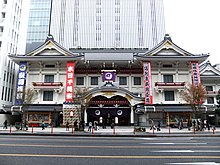

- Akita
- Kosaka
- Tokyo
- Kabuki-za
- Meiji-za
- Shinbashi Enbujō
- National Theater
- Kyoto
- Minami-za
- Osaka
- Shin-Kabuki-za ( 新歌舞伎座 (大阪) )
- Osaka Shōchiku-za ( 大阪松竹座 )
- Nagoya
- Misono-za
- Suehiro-za
- Fukuoka
- Hakata-za
- Kagawa
- Kotohira Kanamaru-za
Influence of kabuki on other fine art forms [edit]
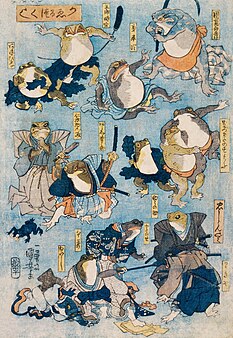
Woodblock print of Famous Heroes of the Kabuki Phase Played by Frogs by Utagawa Kuniyoshi (1798–1861)
Since its first, kabuki has remained a significant slice of Japanese culture. The stories and actors accept been recreated in many dissimilar fine art forms, including woodblock prints, books, magazines, oral storytelling, photography in later years, and others. Additionally, kabuki was and continues to be influenced by the books and stories circulating in Nihon. In 1 such case, the widely popular book Nansō Satomi Hakkenden ,[50] or Eight Dogs, was acted out in various episodes on the kabuki phase.
One important way the laboring class was able to enjoy kabuki performances outside of the stage was through home-brewed shows called Noson kabuki ( の村歌舞伎 , "hamlet kabuki").[51] Also referred to equally "amateur kabuki", these performances took place at the local level beyond Japan, but were near commonly held in the Gifu and Aichi prefectures. In Gifu Prefecture specifically, noson kabuki was a prominent feature of the annual autumn festival, with children's reenactments of kabuki performances taking place at Murakuni shrine for over 300 years.
Closer to the cultural epicenter of kabuki in Edo (later Tokyo), commoners had other methods to enjoy performances without attention the shows. Bunraku ( 文楽 , puppet theatre) [52] was type of performance in Tokyo, simply dissimilar kabuki, it was shorter in length and more than affordable to the common class. Bunraku performances were frequently based on plots used in kabuki, and the 2 styles shared common themes. Kabuki shinpō ( 歌舞伎新報 , "Kabuki news") [53] was another pop medium for kabuki consumption among commoners and elites akin. During the course of its publication, this magazine allowed those unable to nourish performances to savour the liveliness of kabuki culture.
See also [edit]
- Theatre of Japan
- Kanteiryū , a lettering style invented to annunciate kabuki and other theatrical performances
- Kyōgen , a traditional form of Japanese comic theatre that influenced the development of kabuki
- Oshiguma , an imprint of the face make-up of kabuki actors, as artwork and souvenir
- Noh, a traditional form of Japanese theatre
- Bunraku , a traditional Japanese boob theatre from whose scripts many kabuki plays were adapted
- Famous kabuki actor lineages, such as:
- Ichikawa Danjūrō
- Ichikawa Ebizō
- Matsumoto Kōshirō
- Nakamura Kanzaburō
- Kabuki shinpō , a Japanese magazine on kabuki that ran 1879–1897.
- Sgt. Kabukiman NYPD, a 1991 comedic superhero pic directed by Lloyd Kaufman and Michael Herz and distributed past Troma Amusement.
- Kabukibu! , a lite novel, manga, and anime series most a boy who loves kabuki
- Kathakali
- Jingju
- Yakshagana
- Balinese trip the light fantastic toe
Notes [edit]
- ^ "UNESCO – Kabuki theatre".
- ^ a b "Kabuki" in Frederic, Louis (2002). Nippon Encyclopedia. Cambridge, Massachusetts: Harvard Academy Press.
- ^ "Okuni | Kabuki dancer". Encyclopedia Britannica . Retrieved 5 May 2019.
- ^ Haar 1971, p. 83
- ^ a b c d e f g h Masato 2007
- ^ Flynn, Patricia. "Visions of People: The Influences of Japanese Prints Ukiyo-e Upon Tardily Nineteenth and Early Twentieth Century French Fine art". Yale-New Oasis Teachers Institute . Retrieved 9 April 2015.
- ^ a b Lombard, Frank Alanson (1928). An Outline History of the Japanese Drama. London: George Allen & Unwin LTD. pp. 287–295. ISBN978-1-138-91983-9.
- ^ a b c Ernst 1956, pp. 10–12
- ^ Leupp 1997, pp. 91–92
- ^ Leupp 1997, p. 92
- ^ "Mie". Kabuki Jiten. Retrieved 9 Feb 2007.
- ^ a b Kincaid, Zoe (1925). Kabuki: The Popular Stage of Japan. London: MacMillan and Co. pp21–22.
- ^ "Successful Period | History of Kabuki | INVITATION TO KABUKI". www2.ntj.jac.become.jp . Retrieved 26 April 2022.
- ^ Shōriya, Asagoro. Kabuki Chronology of the 19th century at Kabuki21.com (Retrieved 18 December 2006.)
- ^ Brandon 2009
- ^ Abel, Jonathan E (2012). Redacted: the athenaeum of censorship in transwar Japan. Berkeley: Academy of California Printing. ISBN978-0-520-27334-4. OCLC 897200923.
- ^ Takemae, Eiji (2002) [1983]. The Allied Occupation of Nippon. Robert Ricketts and Sebastian Swann (translators and adapters). New York & London: Continuum. pp. 390–391. ISBN0-8264-6247-2.
- ^ Kominz, Laurence (1997). The Stars Who Created Kabuki; Their Lives, Loves and Legacy. Tokyo, New York, London: Kodansha International. p. 232. ISBN4-7700-1868-one.
- ^ a b Toita, Yasuji (1970). "Zenshin-za Innovations". Kabuki: The Popular Theater. Performing Arts of Japan: II. Don Kenny (trans.). New York & Tokyo: Walker/Weatherhill. p. 213. ISBN0-8027-2424-8.
- ^ Shōriya, Asagoro. Contemporary Actors at Kabuki21.com. (Retrieved 18 December 2006.)
- ^ "Kabuki Theaters". Kabuki21.com. 31 Dec 2013. Retrieved 25 July 2014.
- ^ "Ōshika Kabuki". Retrieved 22 Feb 2007.
- ^ Edelson, Loren. Playing for the Majors and the Minors: Ichikawa Girls' Kabuki on the Postwar Stage. In: Leiter, Samuel (ed). Rising from the Flames: The Rebirth of Theater in Occupied Japan, 1945–1952. Rowman & Littlefield, 2009. pp. 75–85.
- ^ a b c Martin, Alex, "Kabuki going strong, 400 years on", Japan Times, 28 December 2010, p. 3,
- ^ Martin, Alex, "Kabuki going potent, 400 years on", Japan Times, 28 December 2010, p. 3, retrieved on 29 December 2010.
- ^ "Kabuki Tours in Asia". Kabuki21.com. Retrieved 25 July 2014.
- ^ "Kabuki Tours in Europe". Kabuki21.com. Retrieved 25 July 2014.
- ^ "Kabuki Tours in North And South America". Kabuki21.com. Retrieved 25 July 2014.
- ^ Za Kabuki Troupe, "Za Kabuki 2012: Who Nosotros Are." Last modified 2012. Accessed 28 April 2013. https://sites.google.com/site/zakabuki2010/who-we-are
- ^ Negishi, G, and Grand Tomoeda. "ANU Za Kabuki." Monsoon, 2010, 26.
- ^ Sign (in English) for Izumo no Okuni's statue in Kyoto
- ^ a b c Alone Planet Kyoto, 2012, page 169
- ^ "2001~2100". Kabuki21.com. Retrieved 25 July 2014.
- ^ "UNESCO Culture Sector – Intangible Heritage – 2003 Convention". Unesco.org. Retrieved 25 July 2014.
- ^ "市川猿翁 2 | 歌舞伎俳優名鑑 現在の俳優篇" (in Japanese). Retrieved 19 Oct 2020.
- ^ "ワンピース・NARUTO・初音ミク 現代の歌舞伎は「超歌舞伎」へ". ワゴコロ (in Japanese). Retrieved 19 October 2020.
- ^ a b Scott 1955, pp. 55–56
- ^ Ukon Ichikawa as Genkurō Kitsune flying over audience Archived 10 Jan 2010 at the Wayback Automobile in the July 2005 National Theatre product of Yoshitsune Senbon Zakura.
- ^ "Archived re-create". Archived from the original on 8 Dec 2015. Retrieved 27 November 2015.
{{cite spider web}}: CS1 maint: archived copy equally title (link) - ^ a b Macintosh, Fiona (30 July 2015), "dance reception", Oxford Inquiry Encyclopedia of Classics, Oxford University Press, doi:ten.1093/acrefore/9780199381135.013.7006, ISBN978-0-19-938113-5 , retrieved nineteen October 2020
- ^ "Kabuki « MIT Global Shakespeares". Retrieved eight April 2015.
- ^ Pronko, Leonard C. (12 February 2015). Samuel L. Leiter (ed.). A Kabuki Reader: History and Operation: History and Performance. p. 248. ISBN9781315706832.
- ^ Leiter, Samuel L. (16 Jan 2006). Historical Dictionary of Japanese Traditional Theatre. p. 115. ISBN9780810865143.
- ^ Quinn, Shelley Fenno. "How to write a Noh play—Zeami'south Sandō. Monumenta Nipponica, vol 48, issue one (Leap 1993). pp53–88.
- ^ a b Toita, Yasuji (1970). Kabuki: The Popular Theater. New York: Weatherhill. pp vi–8.
- ^ Photographic Kabuki Kaleidoscope, I. Somegoro and K. Rinko, 2017. Shogakukan.
- ^ Thornbury, Barbara E. "Sukeroku'southward Double Identity: The Dramatic Construction of Edo Kabuki". Japanese Studies half dozen (1982). Ann Arbor: Center for Japanese Studies, University of Michigan. 13
- ^ a b Miyake, Shutarō (1971). "Kabuki Drama". Tokyo: Nippon Travel Bureau.
- ^ Jones, Stanleigh H. Jr. (trans.)(1993). "Yoshitsune and the Thousand Ruby-red Trees." New York: Columbia University Printing.
- ^ Reichert, James R. (May 2017). "From Yomihon to Gôkan: Repetition and Difference in Tardily Edo Volume Culture". The Journal of Asian Studies. 76 (2): 311–332. doi:10.1017/S0021911817000031. ISSN 0021-9118.
- ^ Hays, Jeffrey. "KABUKI: HISTORY, THEMES, FAMOUS PLAYS AND COSTUMES | Facts and Details". factsanddetails.com . Retrieved 26 April 2022.
- ^ "Bunraku". world wide web.japan-guide.com . Retrieved 26 April 2022.
- ^ 8P. "G06 The Outset Theatrical Mag". The Most Curiosity Kabuki World (in Japanese). Retrieved 26 Apr 2022.
References [edit]
- Brandon, James R. (2009). Kabuki'southward Forgotten War: 1931–1945. University of Hawaii Press. ISBN978-0-8248-3200-1.
- Ronald Cavaye (1993). Kabuki: A Pocket Guide. USA and Japan: Charles Due east. Tuttle,
- Ronald Cavaye, Paul Griffith and Akihiko Senda (2004). A Guide to the Japanese Stage. Nihon: Kodansha International.
- Ernst, Eastward. (1956). The Kabuki Theatre . New York: Oxford Academy Press.
- Scott, A. C. (1955). The Kabuki Theatre of Nippon . London: George Allen & Unwin Ltd.
- Senelick, L. (2000). The Changing Room: Sex, Drag, and Theatre. London: Routledge.
- Facts JPN-kabuki. 25 November 2007 <https://spider web.annal.org/web/20070606160340/http://inic.utexas.edu/asnic/countries/japan/kabuki.html>.
- Japanese Culture. 25 November 2007 <http://nippon-zone.com/civilisation/kabuki.shtml>.
- Kabuki. 25 November 2007 <http://japan-guide.com/eastward/e2090.html>
- Kabuki. Ed. Shoriya Aragoro. ix September 1999. 25 Nov 2007 <http://world wide web.kabuki21.com/>
- Haar, Francils (1971). Japanese Theatre in Highlight: A Pictorial Commentary. Westport: Greenwood P. p. 83.
- Masato, Takaba (2007). "History of Kabuki: Birth of Saruwaka-machi". Watanabe Norihiko. Archived from the original on 20 Jan 2013. Retrieved xxx April 2009.
- Leupp, Gary P. (1997). Male person Colors: The Structure of Homosexuality in Tokugawa Nippon. Academy of California Press. ISBN0-520-20900-1.
Further reading [edit]
- Kawatake, Toshio (2006). Kabuki: Baroque Fusion of the Arts . Tokyo: I-Firm Press.
- Matsui, Kesako (2016). Kabuki, a Mirror of Nippon: 10 Plays that Offer a Glimpse into Evolving Sensibilities . Tokyo: Nihon Publishing Industry Foundation for Culture.
External links [edit]
 | Wikimedia Commons has media related to Kabuki. |
- Kabuki Spider web—Shochiku Official Kabuki Website in English
- Earphone Guide—The English Earphone Guide
- Kabuki 21—All about Japan's traditional Theatre Art of Kabuki: The art, the plays, the neat stars of today, the legends of the past, the theaters, the history, the glossary, the traditions, the heroes and the derivatives.
- National Diet Library: photograph of Kabuki-za in Kyobashi-ku, Kobiki-cho, Tokyo (1900); Kakuki-za (1901); Kakuki-za (1909); Kabuki-za (1911); Kabuki-za (1912); Kakuki-za (1915)
- Kabuki prints past Utagawa Kuniyoshi (1798–1861)
- Japan Mint: Kabuki Coin Set up
- Audio recording of the kabuki play Narukami by Ichikawa Danjūrō I at LostPlays.com
- 1969 'Photographic camera Iii' plan on Kabuki, (audio merely; with Faubion Bowers et al.)
- Collection: "Kabuki Images" from the University of Michigan Museum of Art
- "Kabuki Functioning and Expression in Japanese Prints" exhibition at the Museum of Art and Archaeology at the Academy of Missouri
Source: https://en.wikipedia.org/wiki/Kabuki

Post a Comment for "When Were Wmoen Allowed to Act in Kabuki Again"